Buyer's Guide · Updated June 2026
Organic Moringa Powder: Why It Matters and How to Choose the Right Product
Not all moringa is created equal — and after the moringa recalls of the past year, where your powder comes from matters more than ever. Here's what "organic" really buys you, and a simple checklist to find a moringa you can take every day with confidence.
The short version
- Organic moringa is grown without synthetic pesticides and comes with better records on where and how it was grown.
- Moringa leaf can absorb heavy metals from soil, so clean sourcing matters more than it does for many other greens.
- 2025–26 saw a multistate Salmonella outbreak tied to imported moringa leaf powder, with several brand recalls — a real lesson in why testing matters.
- The word "organic" alone isn't enough. The gold standard is organic plus independent lab testing for heavy metals and pathogens, with results you can see.
01What "Organic Moringa Powder" Actually Means
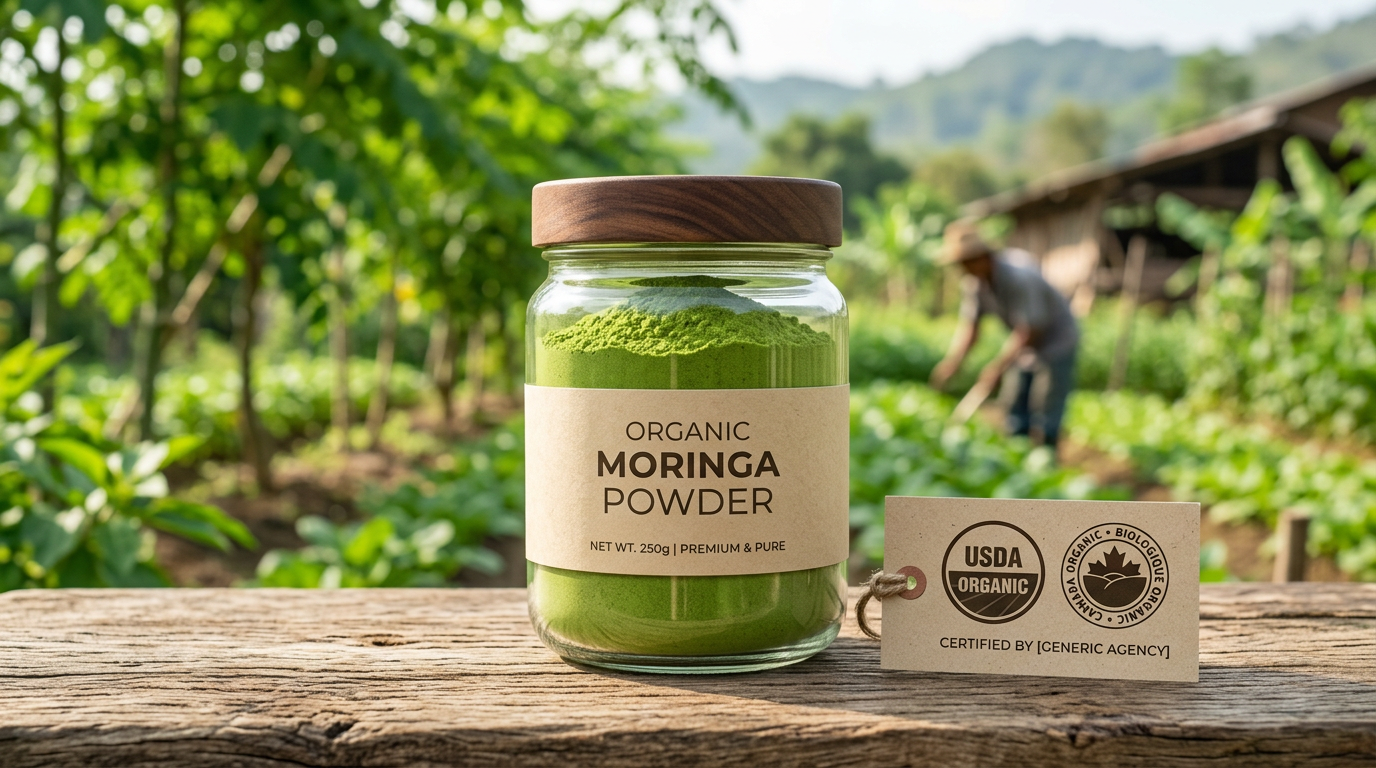
Organic isn't a vibe — it's a certification. To carry a Canada Organic or USDA Organic seal, moringa has to be grown without synthetic pesticides or fertilizers, and the farm has to keep records a certifier can audit.
For a daily green, that paper trail is the real value. You're not just avoiding pesticide residue; you're buying into a system that tracks the plant from soil to jar. With conventional moringa, that history is often a black box. Conventional can still be perfectly good — but you're trusting more and verifying less.
02Why Organic Matters More for Moringa Than Most Greens
Here's the part most product pages skip. Moringa is a fast-growing, deep-rooted tree that's very good at pulling minerals out of the ground — which is part of why it's so nutritious. The flip side is that it can also pull up unwanted things, like heavy metals, if it's grown in poor or contaminated soil.
Independent testing has found that most commercial moringa powders sit below international safety limits for metals like lead and cadmium, but a minority of samples — usually from contaminated soil — can exceed them. (industry overview) The European Union sets clear maximums for dried herbs (for example, 0.30 mg/kg for lead), which is exactly the kind of benchmark a serious lab test should check against.
03The 2025–26 Moringa Recalls: A Wake-Up Call
If you needed proof that sourcing matters, the past year delivered it.
Through late 2025 and into 2026, U.S. food-safety agencies traced a multistate Salmonella outbreak to imported moringa leaf powder used in several "super greens" supplements. By early 2026 the outbreak had grown to well over a hundred reported illnesses and dozens of hospitalizations across more than 30 states, and the FDA and CDC linked the contamination back through distributors to imported leaf powder. (FDA)
Several brands recalled products as the investigation widened, including well-known green-blend supplements sold through major online retailers. (ConsumerLab) Notably, some of the recalled products were labelled "organic" — which is the whole point: organic tells you how the plant was grown, not whether the finished batch was tested for bacteria.
04Organic vs Conventional: What You're Paying For
| Factor | Conventional moringa | Certified organic moringa |
|---|---|---|
| Synthetic pesticides | Allowed | Not allowed |
| Farm record-keeping | Varies | Audited & traceable |
| Heavy-metal risk | Depends on soil/testing | Depends on soil/testing* |
| Pathogen risk | Depends on handling/testing | Depends on handling/testing* |
| Typical price | Lower | Slightly higher |
*This is the key nuance: organic certification doesn't automatically test for metals or bacteria. That's why third-party lab testing is a separate, essential checkbox.
05How to Choose a Safe, High-Quality Organic Moringa
Use this checklist before you buy any moringa powder — organic or not:
- Certified organic. Look for a real Canada Organic or USDA Organic seal, not just the word "organic" in the product name.
- 100% moringa leaf. The ingredient should be moringa leaf — not unnamed "moringa," which can include stems.
- Third-party tested for heavy metals. Lead, cadmium, arsenic, mercury — ideally by ICP-MS at an independent lab.
- Third-party tested for pathogens. Salmonella and other microbes, tested per batch. This is the box the recalled brands couldn't reliably tick.
- A Certificate of Analysis (COA). The best brands publish it or send it on request. No COA, no trust.
- Single, named origin. One country or region beats vague "imported."
- Vivid green colour & a fresh date. Bright green and a recent harvest mean more nutrients and better handling.
06How Vital 1 Moringa Is Sourced
We built Vital 1 around the principles above — clean sourcing, traceability, and one daily dose you can take with confidence.
Vital 1 Moringa is sourced from partner growers at the base of the Himalayas — single-origin, whole-plant Moringa oleifera (leaf, seed and fruit), shade-dried at low temperatures to protect the heat-sensitive nutrients that high-heat commodity drying destroys. Every sachet is one daily serving of the same blend, packed for freshness in Canada and backed by a 60-day money-back guarantee.
Clean moringa, tested every batch
Vital 1 Moringa is whole-plant, single-origin Moringa oleifera — shade-dried at the base of the Himalayas and shipped from Canada. Know exactly what's in your sachet.
See Vital 1 Moringa →07Frequently Asked Questions
Is organic moringa powder better than regular?
Organic means no synthetic pesticides and tighter farm records. Since moringa can draw contaminants from soil, that traceability is more valuable here than with many other greens. Conventional moringa can still be safe and good — but organic plus independent lab testing gives you the most confidence.
Does organic moringa contain heavy metals?
It can contain trace amounts, like most leafy plants. Most powders test below international limits, but levels depend on the soil. The reliable safeguard is a brand that publishes third-party heavy-metal testing — not the word "organic" by itself.
How do I know a moringa brand is safe after the recalls?
Look for per-batch pathogen and heavy-metal testing, a Certificate of Analysis you can actually see, and a clearly named origin. Buying from a brand that controls its own supply chain — rather than repackaging anonymous imported powder — is the single best protection.
Is organic moringa worth the extra cost?
For something you take daily, most people find the small price difference worth the added pesticide protection and traceability — especially when it comes with real lab testing. The thing to avoid is paying extra for "organic" with no testing behind it.
References
- FDA. Outbreak Investigation of Salmonella: Moringa Leaf Powder (January 2026). fda.gov
- ConsumerLab. Why Not Natural Organic Moringa – Green Superfood Recalled. consumerlab.com
- Washington State Dept. of Health. 2026 Salmonella Multistate Outbreak Linked to Moringa Leaf Powder. doh.wa.gov
- NutraIngredients. Moringa recalls spotlight pathogen risks across botanical supply chains (2026). nutraingredients.com
- Overview of moringa heavy-metal testing & EU limits. moringapowder.com