Complete Guide · Updated June 2026
Moringa Powder & Supplements: Benefits, Uses, and How to Choose the Best Brand
Moringa has gone from village staple to wellness-shelf favourite. Here's what the green powder actually does, how to use it without the grassy aftertaste, and how to tell a quality moringa supplement from a weak one — written for real life, backed by real studies.
The short version
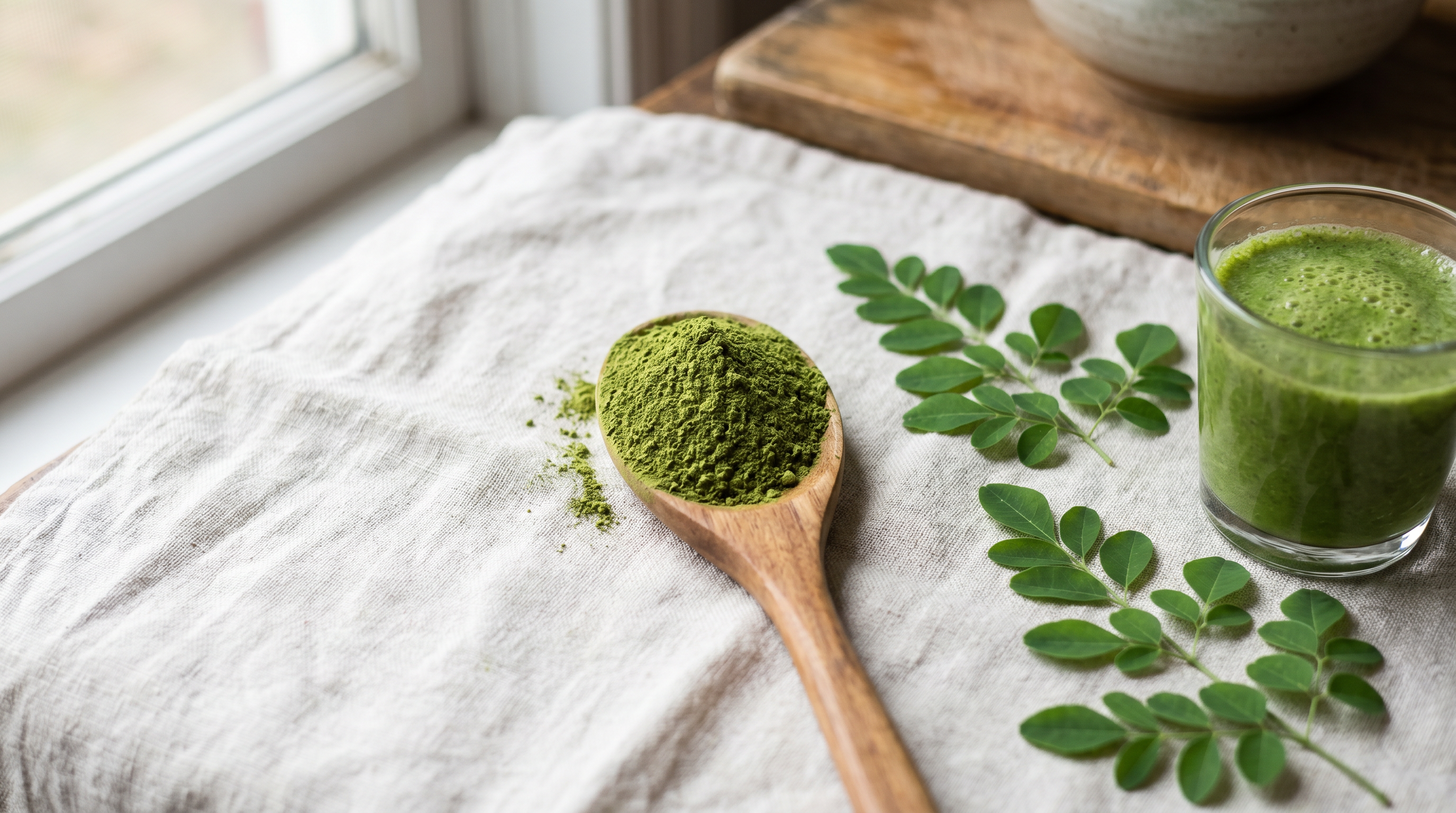
- Moringa powder is dried moringa leaf, ground fine. It packs plant protein, fibre, vitamin A, vitamin C, calcium, iron and antioxidants into a green scoop.
- The best-studied benefits are steadier blood sugar, lower inflammation markers, and a gentle nutrient and energy boost — though results vary and it's a food, not a cure.
- Powder, capsules, tea, and ready-to-drink all work. Powder is the most flexible and best value; capsules are easiest for taste-sensitive people.
- Quality varies a lot. Look for 100% moringa leaf (not stems or root), organic growing, third-party testing, and a recent harvest.
- Skip root and bark products, and check with your doctor first if you're pregnant, breastfeeding, or on medication.
01What Is Moringa Powder?
Moringa powder is made from the leaves of the Moringa oleifera tree — a fast-growing plant from the foothills of the Himalayas that now grows across India, Africa, and Latin America. People have eaten it for thousands of years, and nearly every part of the tree is usable, which is why it picked up the nickname "the miracle tree." (WebMD)
To make the powder, the leaves are picked, dried at low heat, and ground into a fine green flour. Dried this way, moringa keeps for many months without a fridge — handy if you want a daily green that doesn't wilt in three days like spinach.
From the moringa tree to the scoop in your jar
Good moringa powder is a single ingredient: dried moringa leaf, nothing else. The colour tells you a lot. Fresh, well-dried leaf powder is a deep, lively green. If it looks dull, brown, or khaki, it's often old, over-heated, or padded with stems — all of which thin out the nutrition.
Moringa powder vs leaf vs capsules: what's the difference?
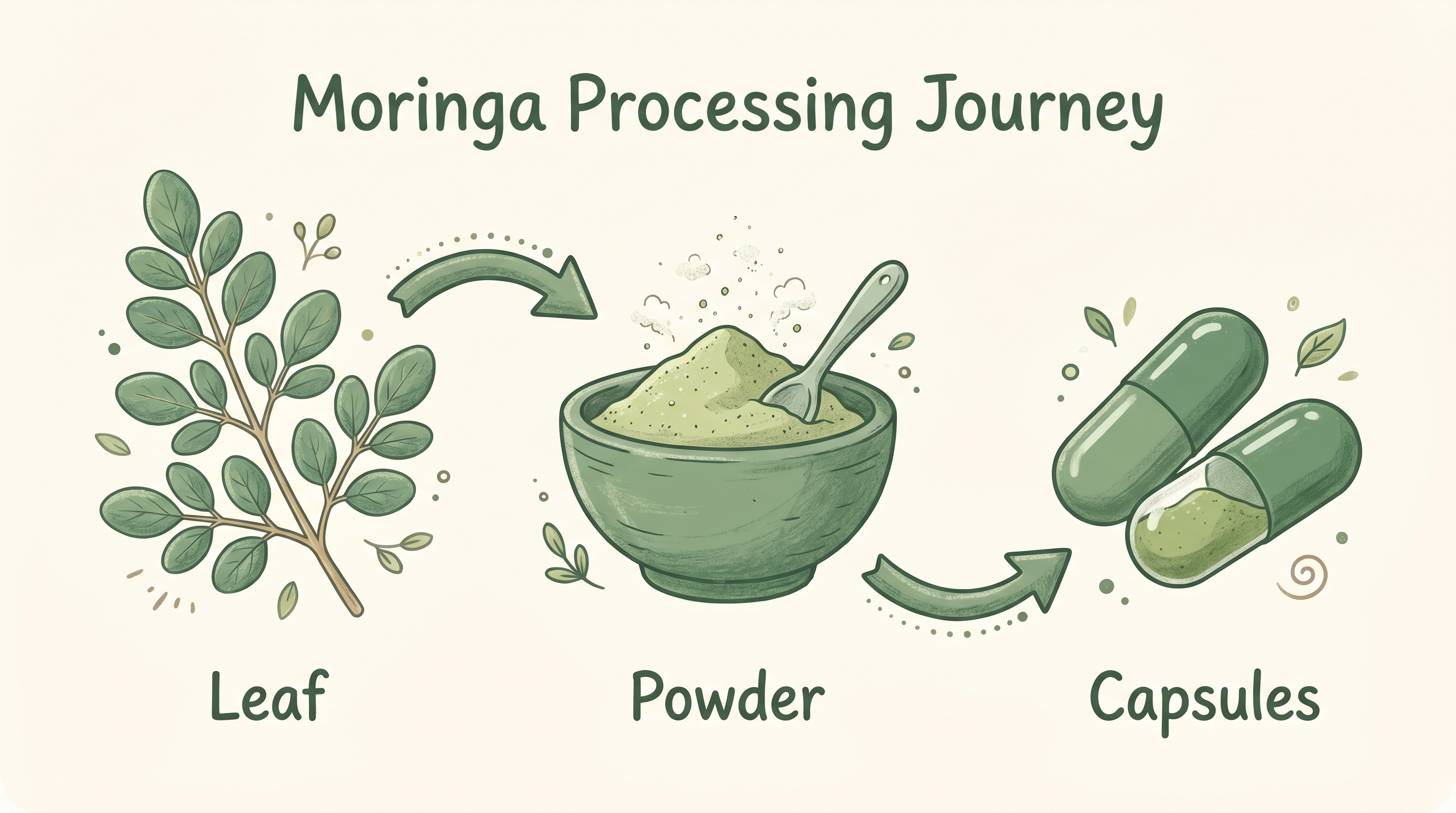
They're the same plant in different packages. Whole dried leaf is what you'd use for tea. Powder is that leaf ground fine, so it blends into food and drinks. Capsules are simply that powder pressed into easy-to-swallow pills.
So how do you pick? It comes down to taste and habit. Moringa powder is the most flexible and usually the best value per serving — you control the dose and stir it into anything. Moringa capsules win if you can't get past the earthy, slightly bitter flavour (a bit like matcha crossed with spinach). Most people who stick with moringa long-term start with powder and keep capsules around for travel.
02Moringa Powder Nutrition Facts and Benefits
The reason moringa earns its hype is density: it delivers a lot of nutrition in a small scoop. Let's look at what's actually inside, then what the research says it can do.
Moringa powder nutrition facts
Dried moringa leaf is roughly one-quarter protein by weight and rich in fibre, healthy fats, vitamins and minerals. In one peer-reviewed analysis, moringa leaf powder came out around 25% protein, 28% carbohydrate, 12% fibre, and 10% fat, with notable beta-carotene (vitamin A), B vitamins, and vitamin C. (Nutrients, 2021) It also brings calcium, iron, potassium, and a stack of plant antioxidants called polyphenols. (PMC review)
What dried moringa leaf is made of
Approximate composition by weight. Real numbers shift with growing region, harvest, and drying — always read your product's label.
Source: nutritional analysis of Moringa oleifera leaf powder, Nutrients (2021). The rest is moisture, ash and micronutrients.
You've probably seen the famous claims — "more vitamin C than oranges, more vitamin A than carrots, more calcium than milk." Those lines trace back to gram-for-gram lab comparisons of dried leaf, and at least the vitamin A and C comparisons show up in the research literature. (Nutrients, 2021) Just keep perspective: a daily serving is a teaspoon or two, not 100 grams, so think of moringa as a top-up to a good diet, not a multivitamin replacement.
Benefits for energy, blood sugar, and inflammation
Steadier blood sugar. This is moringa's most-studied effect. Several human trials have found that daily moringa leaf can lower fasting blood sugar — one 3-month trial in women with type 2 diabetes used 10 grams a day, (Sahrawi RCT, 2025) and a larger 240-person trial saw a meaningful drop in fasting glucose. (RCT, 2025) Results aren't unanimous, though — a short 4-week study in newly-diagnosed patients found no clear difference. (RCT, PMC) Bottom line: promising, but not a replacement for diabetes medication.
Lower inflammation. Moringa is full of antioxidants and compounds called isothiocyanates that appear to calm the body's inflammatory signalling in lab and animal studies. (Life, 2025 review) That's part of why people reach for it for joint comfort and general "feeling run-down" days.
A gentle energy lift. Moringa has no caffeine. Any energy boost comes from filling small nutrient gaps — iron, B vitamins, antioxidants — rather than a stimulant kick. People often describe it as "less drained" rather than "wired," which is exactly what you want from a daily green.
Moringa benefits for men and women
Most of moringa's benefits apply to everyone, but a few searches come up again and again by gender. For women, the draw is usually iron (helpful for those prone to low energy from low iron), calcium, and antioxidant support around hormonal changes. For men, interest tends to centre on energy, blood-sugar and antioxidant support for general vitality. We cover the gender-specific evidence in detail in its own guide — link above.
03Types of Moringa Supplements
Moringa comes in four main formats. None is "best" for everyone — the best one is the one you'll keep using.
Moringa powder
The flexible favourite. You can stir it into water, blend it into smoothies, or sprinkle it over food. Powder lets you control your dose to the gram and usually costs the least per serving, which matters if you're taking it daily. The trade-off is the flavour: it's grassy, and you'll want to mix it with something.
Moringa capsules and tablets
Capsules deliver the same leaf powder with zero taste and zero mess. They're ideal for taste-sensitive people, busy mornings, and travel. The downsides: you'll swallow several capsules to match a powder serving, and you can't sneak it into recipes. For many people the honest answer is "both" — powder at home, capsules in the bag.
Moringa tea and ready-to-drink moringa
Moringa tea is the gentlest entry point: steep dried leaf or a tea bag, and you get a light, green, slightly earthy cup with less intensity than the powder. Ready-to-drink moringa drinks and shots are the most convenient of all — grab and go — but tend to cost the most per serving and sometimes add sugar, so read the label.
| Format | Best for | Taste | Cost / serving |
|---|---|---|---|
| Powder | Daily use, smoothies, value | Grassy (mix it) | Lowest |
| Capsules | Taste-sensitive, travel | None | Medium |
| Tea | Easing in, evening ritual | Mild, earthy | Low–medium |
| Ready-to-drink | Convenience on the go | Flavoured | Highest |
Not sure where to start?
Vital 1 Moringa is a daily single-serve sachet of whole-plant Moringa oleifera (leaf, seed and fruit), shade-dried at the base of the Himalayas. Clean, single-origin, and backed by a 60-day money-back guarantee.
Shop Vital 1 Moringa →04How to Use Moringa Powder Every Day
The number-one reason people quit moringa isn't the price or the benefits — it's that they don't have an easy way to take it. Here's how to make it a habit that sticks.
How to use moringa powder
Start small. Half a teaspoon for the first three or four days lets your stomach adjust, then build to 1–2 teaspoons (about 3–6 grams) a day. The golden rule: pair it with flavour and fat. Moringa's grassy edge softens fast when it meets fruit, citrus, nut butter, or yogurt.
How to take, drink, and consume moringa powder
Easy daily methods, roughly from mildest to boldest tasting:
- In a smoothie — banana, mango or berries hide the flavour completely. The most popular method by far.
- Stirred into juice — orange or apple juice masks it well.
- In yogurt or oatmeal — fold a teaspoon in with a drizzle of honey.
- As a "shot" — whisk into a small glass of water with lemon and a touch of honey, then knock it back.
- Sprinkled on food — over soup, eggs, or a grain bowl after cooking (add at the end to protect the nutrients).
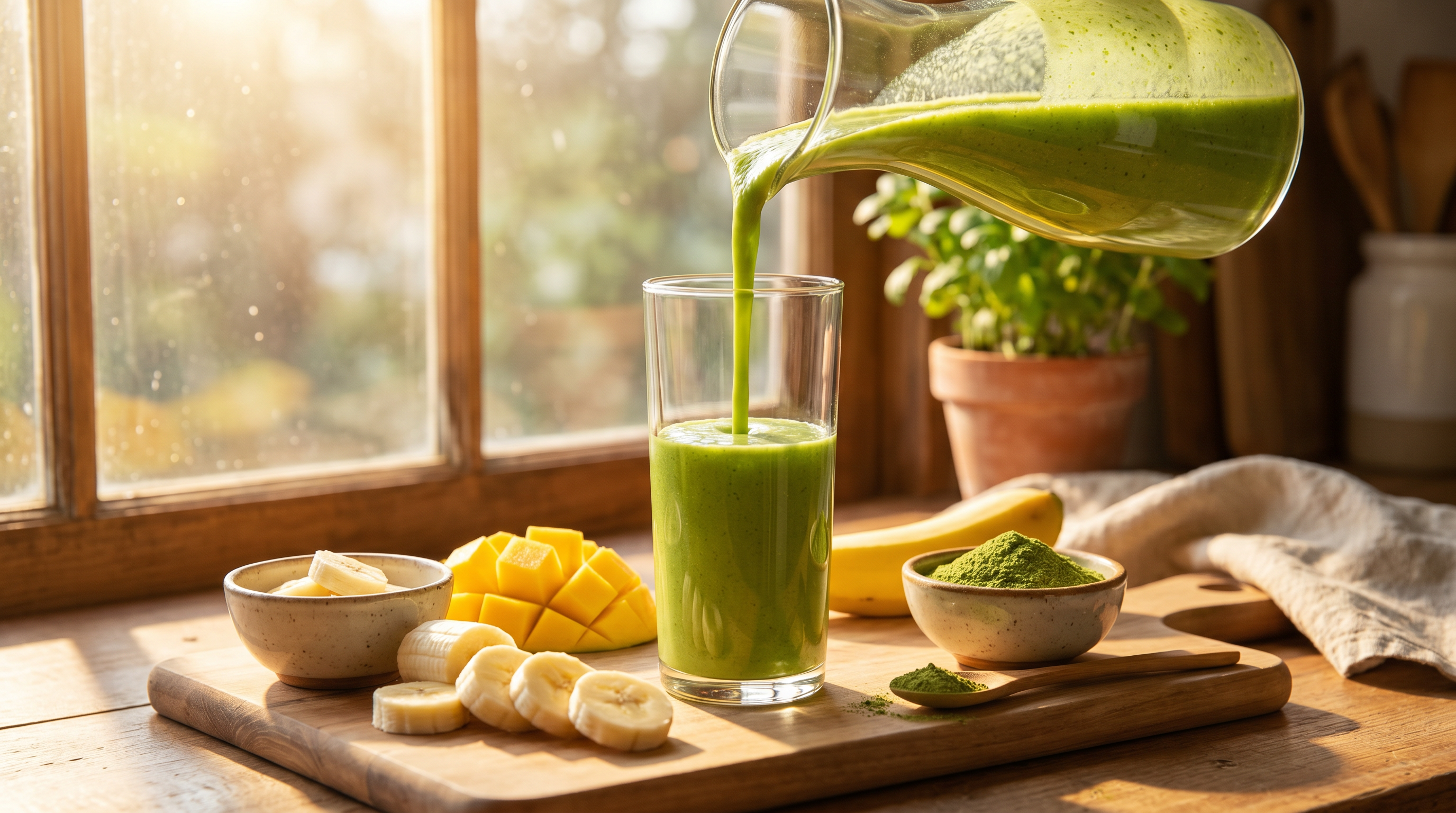
Smoothies and recipes with moringa powder
Searches for moringa smoothies have jumped sharply this year, and it's easy to see why — it's the simplest way in. A reliable starter: 1 banana, a handful of frozen mango, 1 cup of your milk of choice, and 1 teaspoon of moringa powder. Blend. Sweet, smooth, and you'd barely know the green was there.
Best time to take moringa powder
There's no magic hour — consistency beats timing. That said, many people take moringa in the morning because the gentle, caffeine-free lift fits the start of the day, and taking it with food helps your body absorb the fat-soluble vitamins and is easier on a sensitive stomach. If mornings are chaotic, lunch works just as well. The "best" time is the one you'll remember.
05Choosing the Best Moringa Powder or Supplement
Moringa is only as good as the leaf it's made from. Two jars of "moringa powder" can be worlds apart. Here's how to read past the marketing.
Organic moringa powder vs conventional
Because you're taking moringa every day, what isn't in it matters. Certified organic moringa is grown without synthetic pesticides, which is reassuring for a leaf you'll consume daily. Organic certification also usually comes with tighter record-keeping on where and how the plant was grown. Conventional moringa can still be excellent — but with organic you're paying for an extra layer of traceability.
How to evaluate a moringa brand (a 6-point checklist)
- 100% moringa leaf. The label should say leaf — not "moringa" with no part named, which can hide stems or root.
- Vivid green colour. Bright green signals fresh, gently-dried leaf. Brown or grey hints at age or heat damage.
- Third-party testing. Independent lab tests for heavy metals and microbes (like salmonella) are a real trust signal — supplement recalls do happen, so this matters.
- Clear sourcing. A good brand will tell you the country and ideally the region the leaf was grown in.
- Recent harvest / best-by date. Nutrients fade over time; a fresh date beats a bargain on old stock.
- Honest claims. Be wary of "cures everything" language. Trustworthy brands describe moringa as nutritious support, not a miracle drug.
Buying moringa powder in Canada
If you're shopping in Canada, you've got a real advantage: most big search results are US health publishers or marketplaces, and very few Canadian moringa brands explain their sourcing clearly. That makes it easy to comparison-shop on the things that count — leaf purity, testing, and freshness — rather than on flashy packaging. Buying from a Canadian seller also means faster shipping and no surprise customs delays.
Vital 1 Moringa vs other popular brands
Three names come up a lot in the moringa space — here's an honest, plain comparison.
| Brand | Main format | Notable trait | Sold direct in Canada? |
|---|---|---|---|
| Vital 1 Moringa | Daily sachet (drink mix) | Whole-plant (leaf, seed & fruit), shade-dried Himalayan | Yes |
| Isagenix Supermix (formerly Zija) | Drink mix | Multi-level / membership model | Via reps |
| Dynamic Health Moringa | Liquid / juice | Ready-to-drink moringa juice | Mainly US retail |
| Rosabella Moringa | Capsules | Budget capsule option | Marketplace |
06Who Should Use Moringa Powder?
Moringa suits a lot of people — but not everyone, and not in every form. Here's where it fits.
Moringa powder for weight loss
Moringa isn't a fat-burner, and it's fair to be skeptical of any green that promises to melt pounds. What the research does suggest is supportive: in a 12-week trial, overweight participants taking moringa leaf saw small reductions in body weight alongside better cholesterol numbers. (Life, 2025) The realistic role is as a low-calorie, filling, nutrient-rich add-on to a sensible diet — helping with fullness and steadier energy, not doing the work for you. Our full breakdown is linked above.
Moringa for specific conditions
People look to moringa for cholesterol, joint comfort, and menopause symptoms, and early studies are encouraging for some of these — its effects on blood fats and inflammation are the best supported. (Life, 2025) Still, "encouraging early research" is not the same as "proven treatment." If you're managing a health condition, treat moringa as a complement to your care, and loop in your doctor — especially because it can affect blood sugar and blood pressure.
Moringa during pregnancy and breastfeeding
This deserves extra care. Moringa leaf is widely used and is generally considered the safest part of the plant, and it's sometimes taken to support milk supply. But the root, bark, and flowers contain compounds that may trigger uterine contractions and should be avoided in pregnancy entirely. (RxList) Because high-quality studies in pregnancy are limited, the safe move is simple: stick to leaf-only products and talk to your healthcare provider before starting. We cover this fully in our safety guide.
07Frequently Asked Questions
What is moringa powder good for?
It's a nutrient-dense daily green. People use moringa powder for plant protein, fibre, vitamin A and C, calcium, iron and antioxidants. Early human research also links it to steadier blood sugar and lower inflammation — but it's a food supplement that supports a healthy diet, not a medicine that replaces one.
Is moringa powder safe to use every day?
For most healthy adults, yes, in normal food amounts — moringa leaf products have been used with apparent safety for up to about 90 days in studies. (RxList) Start small, choose leaf-only products, and check with your doctor first if you're pregnant, breastfeeding, or taking medication for blood sugar, blood pressure, or thyroid. See our full safety guide.
Can you drink moringa oil or take moringa shots?
Moringa oil is pressed from the seeds and is mainly for cooking and skincare — it's not a daily wellness drink. A "moringa shot" usually means a small, concentrated drink made from moringa leaf powder or juice. For a daily habit, leaf powder, capsules, or a leaf-based drink are the simplest, best-studied choices.
How much moringa powder should I take per day?
A common amount is 1–2 teaspoons (about 3–6 grams) a day, or whatever your product label says. Begin with half a teaspoon for a few days so your stomach adjusts, then build up.
Does moringa have caffeine?
No. Moringa is naturally caffeine-free, which is why it's a good option if you want steady energy without the jitters or an afternoon crash.
References
- WebMD. Moringa Powder: Health Benefits, Safety, Dosage. webmd.com
- Nutritional Value of Moringa oleifera Leaf Powder Extracts. Nutrients, 2021. mdpi.com
- Moringa oleifera: A Prominent Source of Nutrients with Potential Health Benefits. PMC. ncbi.nlm.nih.gov
- Moringa oleifera Lam.: A Nutritional Powerhouse — review of 200+ studies. Life, 2025. mdpi.com
- Moringa leaf powder & glycemic control in women with type 2 diabetes (3-month RCT), 2025. sciencedirect.com
- Moringa leaf and fasting blood glucose in T2DM (240-person RCT), 2025. accscience.com
- Moringa leaf capsules & glycemic control in therapy-naïve T2DM (RCT). PMC. ncbi.nlm.nih.gov
- Moringa — Uses, Side Effects, Precautions. RxList. rxlist.com